
Tech

Maximum Likelihood Estimation (MLE): The Art of Making the Most Likely Choice

Imagine standing in a dense fog with only faint clues about the landscape ahead. You can’t see the entire terrain, but each step you take gives you a bit more information about where you might be. This is the life of a data scientist—navigating uncertainty, inferring patterns, and choosing the most likely explanation for what’s hidden beneath the surface. Maximum Likelihood Estimation (MLE) is the compass that guides this journey—a method that helps us find the parameters that make our data most probable.

Seeing the World Through Likelihood

MLE is not about guessing—it’s about reasoning. Think of it as a detective piecing together a mystery. The evidence (your data) stays the same, but your goal is to identify which explanation (model parameters) best fits the facts. The process begins by assuming a model—say, a bell-shaped curve to represent human height. MLE then adjusts the curve’s parameters (mean and variance) until the observed data seem most likely under that model. In other words, it finds the “sweet spot” where the model and the real world align most harmoniously. For beginners exploring probability-based modelling, joining a data science course offers a hands-on introduction to these mathematical concepts through real-world examples and visualisation exercises.

From Intuition to Mathematics

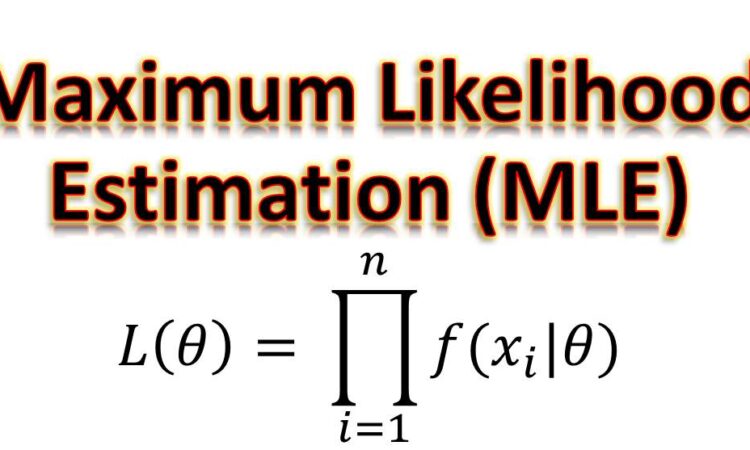
At its heart, MLE seeks to maximise a function called the likelihood. This function measures how well a particular set of parameters explains the data we have. The parameters that give the highest likelihood value are chosen as the best estimates. In mathematical terms, if you have data points x1,x2,…,xnx_1, x_2, …, x_nx1​,x2​,…,xn​ and a model with parameters θ, MLE looks for the θ that maximises L(θ)=P(x1,x2,…,xn∣θ)L(θ) = P(x_1, x_2, …, x_n | θ)L(θ)=P(x1​,x2​,…,xn​∣θ). The task might sound intimidating, but in practice, it’s like fine-tuning a musical instrument until it hits the perfect note. Modern tools automate this process, letting analysts focus on interpreting results rather than solving equations. Students in a data science course in Mumbai often gain exposure to MLE through practical machine learning labs—where theory meets code.

Why MLE Matters in Machine Learning

MLE is foundational to many algorithms that shape today’s intelligent systems. Logistic regression, Gaussian Mixture Models, and Hidden Markov Models all rely on its principles. Its power lies in consistency—the estimates it provides tend to get closer to the true values as more data become available. In simpler terms, MLE gives models the ability to “learn from experience.” As datasets grow, predictions become sharper and more reliable, mirroring how humans refine their understanding over time. This quality makes MLE indispensable in domains ranging from predictive analytics to natural language processing—fields that form the backbone of modern data-driven innovation.

The Role of Assumptions and Limitations

Despite its strengths, MLE isn’t foolproof. It relies heavily on the assumption that the chosen model correctly represents the data. If that assumption fails, even the most sophisticated estimation will lead to misleading results. Moreover, MLE can be sensitive to outliers and computationally demanding for complex models. Data scientists must therefore balance mathematical precision with practical judgment—a balance cultivated through experience and structured learning. A data science course can help professionals build this judgement, offering not just algorithms but also the reasoning needed to choose the right methods for different analytical challenges.

Bringing It All Together

Think of MLE as a navigator’s compass—it doesn’t remove uncertainty, but it ensures that every move you make is guided by evidence, not guesswork. It transforms scattered data points into meaningful direction, allowing models to anchor themselves in reality. For aspiring analysts and researchers, mastering MLE is like learning to read the subtle patterns in the fog. With practice and guidance—perhaps through a data science course in Mumbai—you gain not just technical proficiency, but the mindset to question, test, and discover.

Conclusion

Maximum Likelihood Estimation isn’t just a formula—it’s a philosophy of evidence-based reasoning. It teaches us to embrace uncertainty, to look for patterns in noise, and to make choices that are not merely possible but most likely true. In a world overflowing with data, this principle remains one of the most elegant bridges between probability and insight—a reminder that the best answers often lie where mathematics meets intuition. Business name: ExcelR- Data Science, Data Analytics, Business Analytics Course Training Mumbai Address: 304, 3rd Floor, Pratibha Building. Three Petrol pump, Lal Bahadur Shastri Rd, opposite Manas Tower, Pakhdi, Thane West, Thane, Maharashtra 400602 Phone: 09108238354 Email: [email protected]